IEEE Robotics and Automation Society
Space Robotics Technical
Committee
The Space Robotics Technical Committee has two main areas
of interest: Microgravity and Planetary
Robotics. Microgravity Robotics includes
manipulation and mobility for scenarios such as International Space Station
(ISS) operations and satellite servicing.
Planetary Robot systems address scenarios such as Mars and lunar
exploration using manipulation or mobility on or near the surface. Some scenarios, such as asteroid and comet
exploration, have environments with low gravity which may blur the distinctions
between these categories.
1.
Overview
MICROGRAVITY
ROBOTICS

The
Dextre robot on the International Space Station
For Microgravity Robotics the space environment (radiation,
contamination sensitivity, thermal extremes, etc.) poses unique challenges to
robot and robot algorithms. Despite this, it is expected that the robotics
discipline will find increasing importance in coming years, particularly as the
opportunities for human-robot and robot-robot cooperation arise in space
exploration. Priority areas for this technical committee include:
• Electromechanical
design and control.
• Microgravity
locomotion.
• Machine
vision for inspection and assembly, including compensation for stark lighting,
glare, glint, and deep shadows.
• Command
and control interfaces, including teleoperated modes.
• Power
sources and consumable recharging techniques.
• Radiation
hardening and effects on processing throughput.
• Thermal
considerations in space robot design.
Below
is a list of historical and upcoming missions that define the state of the practice
in orbital robotics:
•
DLR ROTEX
(1993) – 6 DOF autonomous manipulation experiment on ISS
•
JAXA ETS-VII (1997-1999) – first satellite to be equipped with a
robotic arm.
•
CSA Canadarm 2 (2001) – service crane for the ISS assembly
and maintenance.
•
DLR ROKVISS
(2005-2010) – a 2 DOF manipulation hardware test bed outside ISS
•
MIT SPHERES (2006-present) –
internal microsatellite testbeds aboard ISS.
•
JAXA JEM-RMS
(2009) – service arm on ISS.
• DARPA Orbital Express (2007) – autonomous satellite grappling.
•
CSA Dextre (2008-present) –
dual-armed external support system on ISS
•
NASA JSC Robonaut
2 (2010-present) – dual-armed experimental system internal to ISS
•
NASA GSFC Robotic
Refueling Mission (2013) – ISS manipulation experiments.
• NASA Raven (2016) – ISS autonomous
navigation and guidance system technology demonstrator.
• NASA Restore-L (2020) –satellite
refueling mission.
• DARPA Phoenix Mission (2020) – multiple
satellite repairs.
Additionally,
it is valuable to mention these important research systems for orbital
robotics:
•
Internal
Systems – ESA COLUMBUS,
•
External Systems – JAXA REX-J, ESA EUROBOT
PLANETARY
ROBOTICS
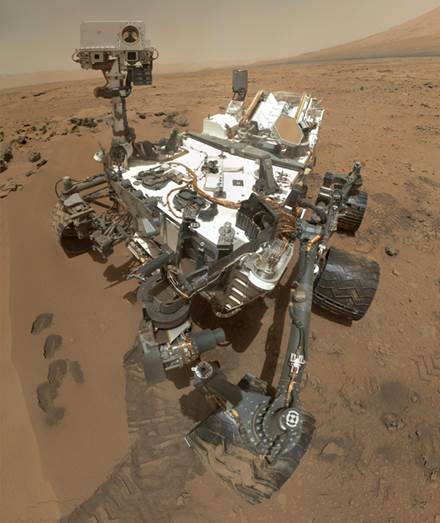
NASA’s
“Curiosity” Rover operating on Mars.
For Planetary Robotics, the surface environment also poses
unique challenges. These include Microgravity Robotics’ issues during cruise
phase, or if an atmosphere is not present.
Further, there is usually the greater uncertainty of interacting with an
unexplored natural terrain instead of man-made structures. Planetary Robotics
technical topics include:
• Sensing
and perception for planetary exploration, including terrain-relative precision
position estimation.
• Above-surface,
surface, and sub-surface planetary mobility, possibly from novel vehicle design
concepts.
• Command
and control with limited bandwidth, often precluding teleoperation and
requiring autonomous surface operations, with natural terrain navigation and
manipulation.
• Planetary
rovers systems engineering.
• Testing
and qualification, including field tests on Earth and Mars.
• Human-Robot
system design and development.
Below
is a list of historical and upcoming missions that define the state of the
practice in planetary rovers:
• NASA
Pathfinder Sojourner
Rover (1997) – small solar powered Mars rover experiment.
• NASA MER (2003-present) –
dual solar powered Mars rovers, one still alive.
• JAXA Minerva (2005) – low
gravity hopper for asteroid surface, but unsuccessful in reaching on the
target.
• NASA MSL (2011-present) – RTG powered Mars
rover.
•
CNSA Chang’e
3 Yutu Rover (2013)
– solar powered lunar rover.
•
JAXA Hayabusa-2 (2014)
– carrying low gravity mobile robots for asteroid
surface: Japanese MINERVA-2 and DLR/CNES MASCOT .
•
ESA ERA
(2017) – European Robotic Arm on ISS.
•
JAXA SELENE-2 Rover (2018) – short
duration lunar rover.
•
ISRO Chandrayaan-2 (2018) –
carrying RKA Luna-Resurs solar powered lunar rover.
•
CNSA Chang’e 4
Yutu-2 Rover (2018) – solar powered lunar rover.
•
NASA M2020
Rover (2020) – RTG powered Mars rover.
•
ESA ExoMars Rover (2022) – solar powered Mars rover.
•
NASA
/ ESA Mars Sample Return (2026) – lander, rover, and manipulation systems.
• Google Lunar X Prize (2020’s) –
contest for lunar exploration.
• Korean
Lunar Exploration (2020’s)
– lunar lander and rover.
Additionally, it is
valuable to mention these important research systems for planetary surface
mobility:
•
Roving – NASA JPL Robosimian, NASA JPL ATHLETE,
NASA JSC SEV, CSA Rover
prototypes.
• Steep Terrain – NASA JPL Axel.
•
Low gravity – Stanford/JPL Hedgehog,
QUT LunaRoo
2. News
Recent
news on space robotics is available from IEEE Spectrum News on
Space Robotics.
3. Future Activities
2021
1.
IEEE Aerospace Conference,
Big Sky, Montana, USA, 6-13 March 2021. Special sessions, including “Robotic
Mobility and Sample Acquisition Systems”.
2020
1. Workshop on Planetary Exploration Robots,
International Conference on Intelligent Robots and Systems (IROS), Las Vegas, Nevada,
USA, 29 October 2020.
2. Robotic In-Situ Manufacturing, Structural Assembly
and Servicing. Workshop at the IEEE/RSJ International Conference on Intelligent
Robots and Systems (IROS), Las Vegas, Nevada, USA, 25-29 October 2020. (hq.wvrtc.com/iros2020/)
3. International Symposium on Artificial Intelligence, Robotics and
Automation in Space (i-SAIRAS), Pasadena, California, USA, 18-21
October 2020
4. Past Activities
2020
1.
Opportunities
and Challenges in Space Robotics, online workshop for the IEEE International
Conference on Robotics and Automation (ICRA), 2 June 2020.
2.
IEEE Aerospace
Conference, Big Sky, Montana, USA, 6-13 March 2020. Special
sessions, including “Robotic Mobility and Sample Acquisition Systems”.
2019
1.
Space
Robotics. Workshop at Robotics
Science and Systems Conference, Freiburg im Breisgau,
Germany, 22-26 June 2019.
2. Robotic Technology for In-Space
Assembly. Half-day Workshop at the IEEE International Conference on
Robotics and Automation (ICRA), Montreal, Quebec, Canada, 23 May 2019.
3.
IEEE Aerospace
Conference, Big Sky, Montana, USA, 2-9 March 2019. Special
sessions, including “Robotic Mobility and Sample Acquisition Systems”.
2018
1. Autonomous
Space Robotics. Workshop at Robotics Science and Systems Conference, Pittsburgh,
Pennsylvania, USA, 29 June 2018.
2. International Symposium on Artificial
Intelligence, Robotics and Automation in Space (i-SAIRAS), Madrid,
Spain, 4-6 June 2018.
3.
IEEE Aerospace
Conference, Big Sky, Montana, USA, 3-10 March 2018. Special
sessions, including “Robotic Mobility and Sample Acquisition Systems”.
2017
1.
11th
Conference on Field and Service Robotics (FSR), Zurich, Switzerland, 12-15
September 2017
2. IEEE Aerospace Conference, Big Sky,
Montana, USA, 4-11 March 2017. Special sessions, including “Robotic
Mobility and Sample Acquisition Systems”.
3.
Gravity
Offload Testbeds for Space Robotics Mission Simulation Workshop, Full-day
Workshop at the IEEE/RSJ International Conference on Intelligent Robots and
Systems (IROS), Vancouver, Canada, 24 September 2017.
2016
1. International Symposium on Artificial
Intelligence, Robotics and Automation in Space (i-SAIRAS), Beijing,
China, 19-22 June 2016.
2.
IEEE Aerospace Conference, Big
Sky, Montana, USA, 5-12 March 2016. Special session on “Robotic Mobility and
Sample Acquisition Systems”.
2015
- 10th
Conference on Field and Service Robotics (FSR), Toronto, Canada, 24-26
June 2015.
- 13th
Symposium on Advanced Space Technologies in Robotics and Automation,
ESA/ESTEC, Noordwijk, The Netherlands, 11-13 May
2015.
3.
The
Next Generation of Space Robotic Servicing Technologies, Full-day Workshop
at the International Conference on Robotics and Automation (ICRA), Seattle,
USA, 26 May 2015.
4.
IEEE Aerospace
Conference, Big Sky, Montana, USA, 7-14 March 2015. Special session on “Robotic
Mobility and Sample Acquisition Systems”.
2014
1.
Workshop
on “Modeling, Estimation, Perception and Control of All Terrain Mobile Robots” IEEE International
Conference on Robotics and Automation (ICRA), Hong Kong, China, May 2014.
2.
IEEE/AIAA
Aerospace
Conference, Big
Sky, Montana, USA, 1-8 March 2014.
Special sessions, including “Mobility and
Robotics Systems for In Situ Exploration”.
3.
Journal of Field Robotics, Special Issue on Space
Robotics. Call
for papers, due 19 September 2014.
2013
1.
Space
Robotics Workshop, IEEE International Conference on Robotics and Automation
(ICRA), Karlsruhe, Germany, May 2013.
2. IEEE/AIAA Aerospace
Conference, Big
Sky, Montana, USA, 2-9 March 2013.
Special sessions, including “Mobility and
Robotics Systems for In Situ Exploration”.
2012
1. International Symposium on Artificial
Intelligence, Robotics and Automation in Space (i-SAIRAS), Turin, Italy,
4-6 September 2012.
2. International Conference on
Field and Service Robotics, Matsushima, Miyagi, Japan, 16-19 July 2012.
3. Long-Term Autonomy
Workshop. IEEE International Conference
on Robotics and Automation, St. Paul, Minnesota, 18 May 2012.
4. Satellite Servicing
Workshop. IEEE International Conference on Robotics and
Automation, St. Paul, Minnesota, 14 May 2012.
5. Exploration Telerobotics Symposium.
Hosted by NASA Goddard Space Flight Center, Greenbelt, Maryland,
USA. 2-3 May 2012
6. IEEE/AIAA Aerospace
Conference, Big
Sky, Montana, USA, 5-12 March 2012.
Special sessions, including “Mobility and
Robotics Systems for In Situ Exploration”.
2011
1. Challenges in Robotics: Down to
Earth, An International Symposium on Robotics and Mechatronics, German Aerospace
Center (DLR), Wessling, Germany, 21-22 November 2011.
2.
Workshop
on Space Robotics Simulation, IEEE/RSJ International
Conference on Intelligent Robots and Systems (IROS), San Francisco,
California, USA, 26 September 2011.
3.
Space
Robotics Workshop, IEEE International Conference on Robotics and
Automation (ICRA), Shanghai, China, 13 May 2011.
4. IEEE/AIAA Aerospace
Conference, Big Sky,
Montana, USA, 5-12 March 2011.
Special sessions, including “2.07 –
Mobility and Robotics Systems for In Situ Exploration”.
2010
1.
Japan-U.S. Technology and Space Applications (JUSTSAP), Island of Hawaii, USA
14-18 November 2010. Symposium was attended by SRTC member Rick
Wagner, who provided a report.
2.
Planetary
Rovers Workshop, IEEE International Conference on Robotics and
Automation (ICRA), Anchorage AK, 3 May 2010.
3.
Space
Robotics TC Triennial Report, May 2010.
2009
1.
IEEE
Robotics & Automation Magazine, Special Issue on Space Robotics. Editors:
Richard Volpe, Rick Wagner, Gianfranco Visentin. Volume 16, No. 4. December
2009.
2008
1.
Planetary
Rovers Workshop, IEEE International Conference on Robotics and
Automation (ICRA), Pasadena CA, 19 May 2008.
2.
Orbital
Robotics Workshop, IEEE International Conference on Robotics and
Automation (ICRA), Pasadena CA, 20 May 2008.
2007
1. Space
Robotics Workshop, IEEE International Conference on Robotics and
Automation (ICRA), Rome Italy, 14 April 2007.
2.
Presentation
of the RAS Space Robotics TC to the AIAA SARTC meeting at NASA Ames Research Center
on September 19, 2006. See a report on the meeting.
3. Background
Founding date:
May 19, 2006
Committee Chairs as of 2016:
• Richard Volpe,
Jet Propulsion Laboratory, Caltech.
• Kazuya
Yoshida, Tohoku University.
• André
Schiele, Delft University of Technology.
Membership:
• Current membership is 28. Please see the membership
page for more details.
• To join, send an email to the committee chairs
listed above.
4. Links